
Write an abstract
An abstract is the whole work in one paragraph. Reviewers of a conference decide on it alone. Readers of a paper decide from it whether to read on.
One paragraph, four moves
Section titled “One paragraph, four moves”A research abstract is normally one paragraph with no headings. Inside it, the reader still expects four things, in this order:
| Move | Question it answers | Share of the words |
|---|---|---|
| The problem | What is the problem, and why does it matter? | About a fifth |
| What you did | How did you study it? | About a quarter |
| What you found | What are the results? | About a third |
| What it means | What follows, and for whom? | About a fifth |
You do not write these labels. The sentences do the work. The results are the heart of it: an abstract with no result reads as a promise, and reviewers mark it down.
A worked example
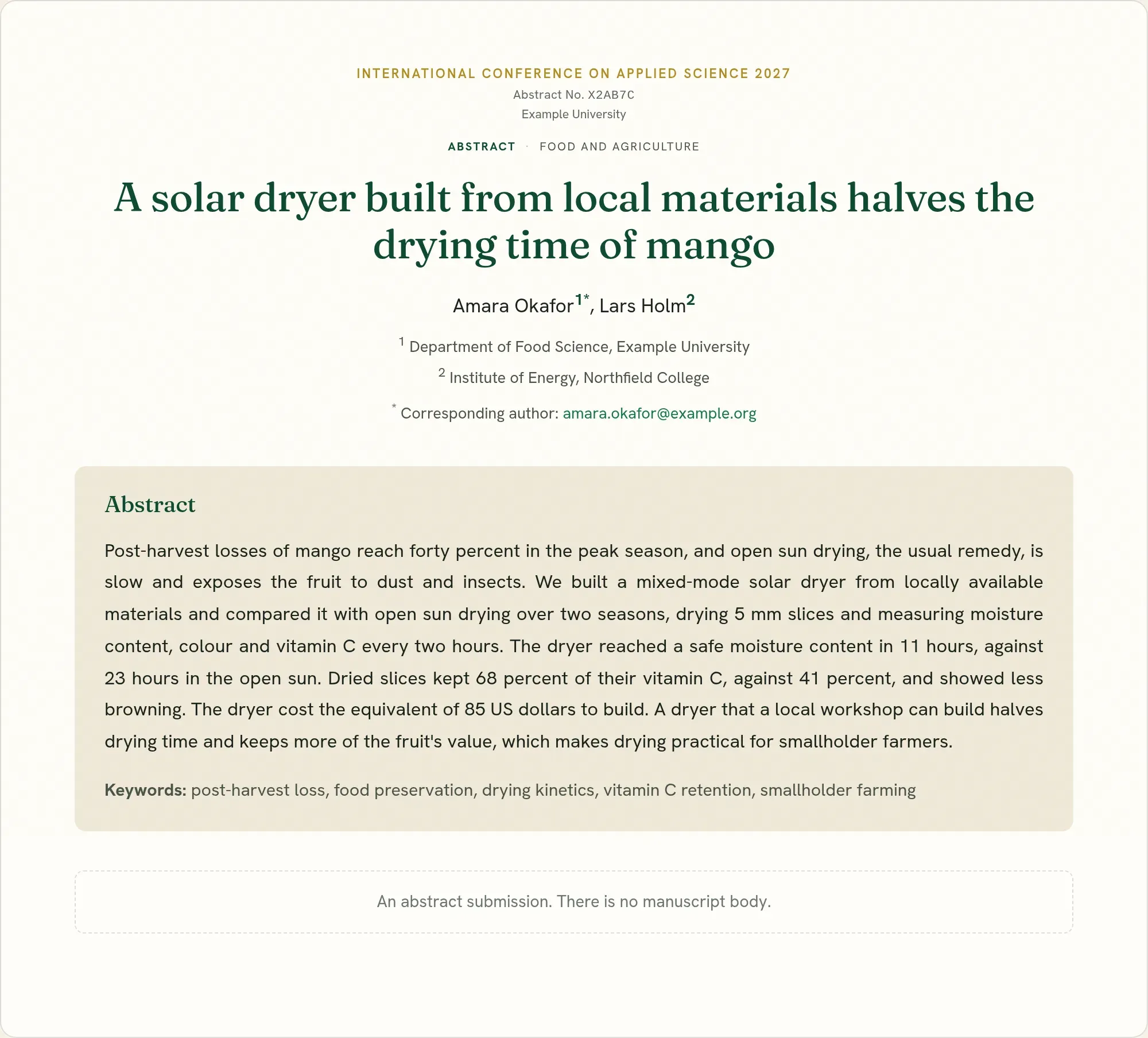
Section titled “A worked example”Post-harvest losses of mango reach forty percent in the peak season, and open sun drying, the usual remedy, is slow and exposes the fruit to dust and insects. We built a mixed-mode solar dryer from locally available materials and compared it with open sun drying over two seasons, drying 5 mm slices and measuring moisture content, colour and vitamin C every two hours. The dryer reached a safe moisture content in 11 hours, against 23 hours in the open sun. Dried slices kept 68 percent of their vitamin C, against 41 percent, and showed less browning. The dryer cost the equivalent of 85 US dollars to build. A dryer that a local workshop can build halves drying time and keeps more of the fruit’s value, which makes drying practical for smallholder farmers.
That is 132 words, in one paragraph. Read it again with the four moves in mind:
| Sentence | What it does |
|---|---|
| “Post-harvest losses of mango reach forty percent… dust and insects.” | The problem, with its size, in one sentence. |
| “We built a mixed-mode solar dryer… every two hours.” | What was done, with the numbers a reader needs to judge it. |
| “The dryer reached… 85 US dollars to build.” | What was found. Three sentences, and every one has a number and a comparison. |
| “A dryer that a local workshop can build… smallholder farmers.” | What it means, and who gains. |
As it looks on Quorum Press
Section titled “As it looks on Quorum Press”This is the same abstract, with its title, authors and keywords, as the preview shows it and as reviewers will read it.
Write it in this order
Section titled “Write it in this order”- What you found, first. Write the two or three findings, with numbers.
- What it means. What follows from those findings, and no more.
- What you did. Only what a reader needs in order to trust the results.
- The problem, last. One or two sentences that lead to the question.
- Join them into one paragraph that reads straight through, in the order problem, method, findings, meaning.
- Cut. Remove every word that can go.
Common mistakes
Section titled “Common mistakes”| Mistake | Fix |
|---|---|
| Half the abstract is background. | Two sentences at most. The reviewers know the field. |
| Headings nobody asked for. | One paragraph, unless the call asks for a structured abstract. |
| “Results will be discussed.” | State the result. If the work is not finished, say what you have so far. |
| No numbers. | Give the size of the effect, the sample, the comparison. |
| The conclusion claims more than the results show. | Claim only what you measured. |
| Abbreviations nobody knows. | Write the words in full. Abbreviate only what you use three times or more. |
| Citations and footnotes. | An abstract stands alone. Leave references out unless the call asks for them. |
| “In this paper we…” repeated. | Say what you did directly: “We built…”, “We compared…”. |
| A table or a figure. | Not in an abstract. |
When the work is not finished
Section titled “When the work is not finished”Conferences often take abstracts before the work is complete. Be honest about it:
- Say what you have found so far, even if it is early.
- Say what you will have by the date of the conference.
- Never invent a result. A reviewer who finds out will not trust the rest.
A conference abstract and a paper’s abstract
Section titled “A conference abstract and a paper’s abstract”| Conference abstract | Abstract of a full paper | |
|---|---|---|
| Read by | Reviewers deciding whether to accept it | Readers deciding whether to read the paper |
| Stands alone | Yes, it is the whole submission | Yes, it is indexed without the paper |
| Length | Often 250 to 300 words | Often 150 to 250 words |
| Printed in | The book of abstracts | The paper and the indexes |
Check it
Section titled “Check it”- Could a reader repeat the main finding after one reading?
- Is there at least one number in the results?
- Does the conclusion follow from the results given?
- Is it within the word limit? The editor counts for you.
- Did someone outside your group understand it?
Next: Title and keywords, or submit it.
Quorum PressOpen callsRead researchSomething missing or wrong here? Tell us